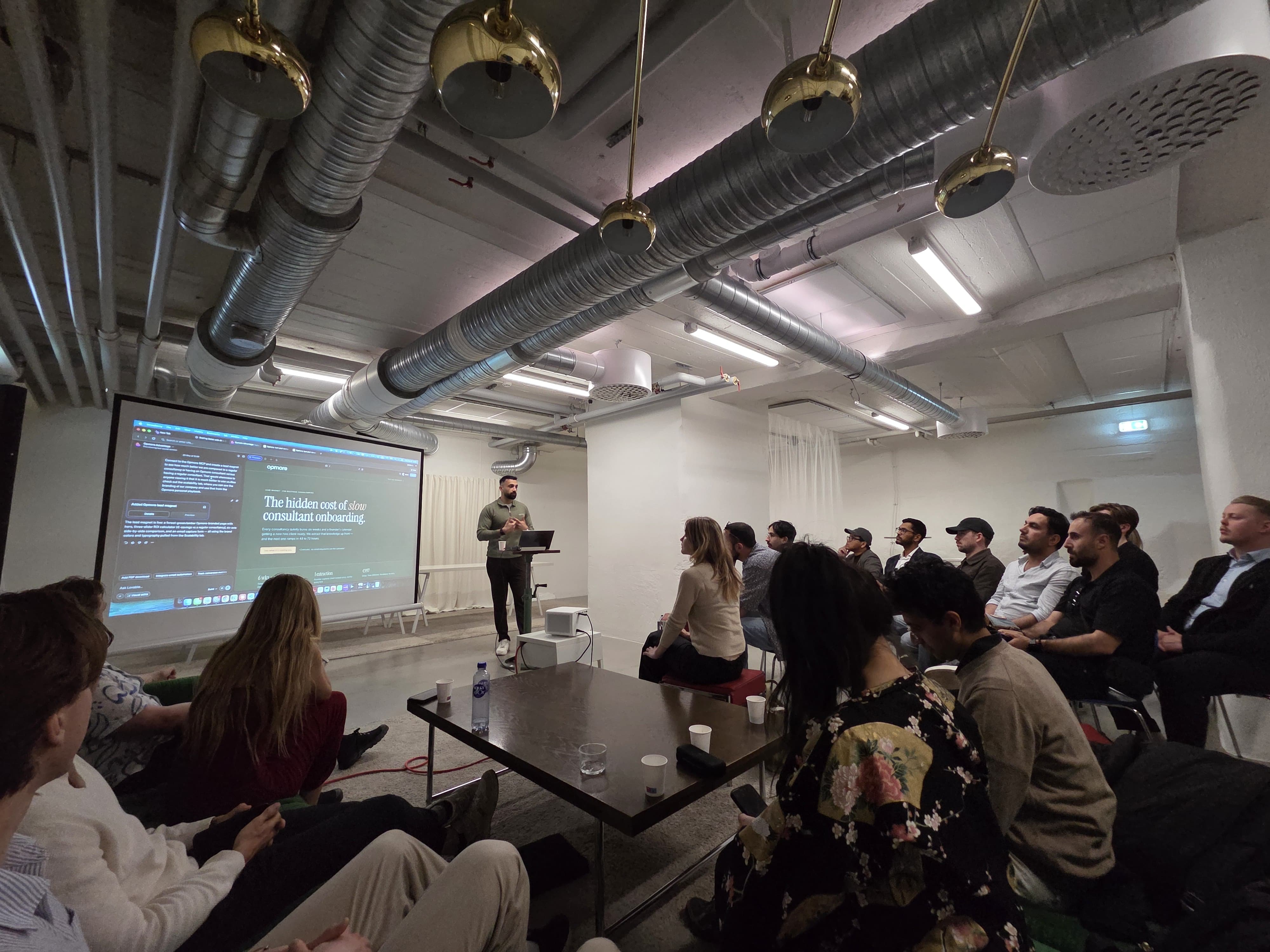
We ran a workshop in Stockholm on May 28 with Sakura, Strawberry Browser, and Garba. One hour, a room full of founders, and one question on the table: what does AI in sales actually look like in 2026 when you build it properly?
This is the digest. The mental model, the data points worth remembering, and the offer.
If you're not selling, you're running a very expensive hobby.
The context gap
Founders close the first deals on personal hustle, not on a system. It works until they try to hire or scale. Then it breaks.
- 70% of first sales hires in startups fail inside 12 months.
- A failed sales hire costs a €3M ARR startup roughly €1.2M once you count salary, lost pipeline, and valuation hit.
- Sales that's systematised exits at 2x the multiple of sales that isn't.
The reason is what I call the context gap. The founder has two years of pattern-matching in their head: who the buyer is, what they push back on, what wins them over. The new hire walks in with none of that. The AI doesn't have it either, which is why most AI-in-sales projects produce the same generic outbound, just faster.
What AI actually changed
AI didn't make sales easier. It made the system cheaper to build. What used to need a sales ops team of three now needs a founder, a laptop, and the right stack.
- 81% of sales teams use AI today.
- 95% of AI spend shows zero bottom-line impact (MIT, 2025).
- Sellers who use AI well are 3.7x more likely to hit quota (Dominguez, 2026).
The gap between "uses AI" and "wins with AI" is the gap between buying a tool and wiring it into a system that compounds.
The three-layer pattern
This is the mental model. Three layers. The brain is the moat. The agents and the tools are commoditised.
1. The Brain. ICP, voice, sales process, call transcripts, customer wins, pricing logic. What makes you different from every other AI implementation. Lives in a structured repo, not in 47 Notion pages no one opens.
2. The Agents. Claude or any other LLM that reads from the brain, decides what to do, and calls tools. Never generates in a vacuum. Always contextualised.
3. The Tools. CRM, email, calendar, Slack, Gong. Reached via MCP or API. Interchangeable. Swap HubSpot for Attio without rebuilding anything else.
If you skip the brain and start at layers two and three, you've built a faster way to send generic outreach. That's most of the 95%-no-gain bucket.
OPTICS: how we structure the brain
Six pillars. Every cell filled with how YOU sell, ship, and run. That's what makes the agents specific to you, not generic.
| Pillar | What lives here |
|---|---|
| O Offering | Product, pricing, competition, proof, ecosystem |
| P Prospecting | Outbound, marketing, network |
| T Targeting | ICP, personas, triggers |
| I Insights | Research, patterns, market |
| C Conversion | Stages, calls, closing, recovery, retention |
| S Scalability | Brand, people, hiring, systems |
MEDDIC and SPICED are conversation frameworks for a single deal. OPTICS is the company scaffold that sits underneath them. Once it's filled, any agent or new hire can read from it and operate at near-founder context from day one.
The 95% rule
The data point that should change how you spend your week:
95% of your buyers are not ready to buy right now.
Ehrenberg-Bass / LinkedIn B2B Institute. Most founders pour all their outbound at the 5% in-market this week. The real game is being the obvious choice when one of the 95% wakes up.
And by the time the 5% reaches out, the deal is mostly decided. 70% of the buying journey happens before they ever speak to you. 81% have a preferred vendor before first contact. They research on G2, in Slack groups, with ChatGPT, with peers. Your content, your reputation, and your social proof do most of the selling before you even know they exist.
This is why inbound is not optional. If you only hunt the 5%, you're fighting to get on a shortlist that's already written.
Trust earns the meeting
The 95% won't wake up to a stranger pitching. They'll wake up to someone they already trust. Four levers worth being deliberate about:
- LinkedIn. Founder-led posts get 7x more impressions than company pages. Storylane publicly attributes more than 50% of its pipeline to founder content.
- Banner and headline. Says who you help and how, in three seconds. Not "CEO at X."
- Events. One in-person conversation is worth fifty cold messages. If you want to close a big deal, sit next to their coffee machine and wait.
- Follow-ups. Most deals close after touch five. Most founders quit at touch two. The deal is alive. You stopped showing up.
84% of executives review your online presence before deciding to work with you. Trust is already being scored. You just don't see the scorecard.
Word of mouth is the most underrated channel in B2B. Referrals convert at 14.6% vs 4.8% for inbound, and close 4x faster. If you don't have a "who else should I be talking to?" at the end of every happy conversation, you're leaving your highest-converting pipeline source on the floor.
Outbound: the shape that works
Same shape, every time. Five stages, AI plugs into all of them.
- Find. Strawberry Browser running agents against LinkedIn and the web, building qualified lists in twenty minutes.
- Enrich. Clay or Apollo adding signals: funding, hires, intent, tech stack. Personalised outreach pulls 2x reply rate, signal-based personalisation pulls 3 to 5x.
- Store. CRM that updates itself. At Opmore we run a Postgres database the agents write to natively. No one has touched a CRM UI in weeks.
- Reach out. Multi-channel sequence. Always open on LinkedIn. Rotate through DM, call, email, voice memo, video. Multi-channel pulls 3x the reply of single-channel. Don't take silence as a no.
- Convert. Garba captures every call, updates the CRM, drafts the follow-up in your voice, and surfaces patterns across deals as coaching signal.
Anatomy of a message
Five parts: subject, relevance, problem, value plus proof, CTA. Same prospect, two different outcomes:
The reply-killer:
Subject: Touching base re: synergies
Hi [Name], I hope this message finds you well. We've spent the last 3 years developing a proprietary methodology backed by 47 data points across 12 industries. We've served 200+ clients with an average NPS of 72. Would love to schedule a 45-min discovery call to walk you through our full feature set.
The one that lands:
Subject: 5G revenue
Hey Frank, the 5G and fiber campaigns look very tailored across all of T-Mobile's geos. Multiple builds, QA, and compliance checks can take weeks if ops is the bottleneck. Amazon used Opmore to launch hundreds of personalised landing pages in a day instead of weeks. Can I show you how?
Two things from Gong's reply-rate data worth burning in: the word "AI" in a cold email cuts reply rate by a third. Asking for a meeting before they trust you cuts it by half. Open with social proof. Close with an offer, not an ask.
Where Opmore fits
Two paths. If you already have a stack (HubSpot, Apollo, Fathom, whatever), we sit on top as the brain layer. Our agents speak MCP. They read from your tools and write back to your tools. No migration.
If you're starting fresh, we bring the whole stack: playbook portal, agent-native Postgres CRM, MCP integrations, our agents live from day one. You own the brain. We maintain it.
You can build this yourself in six months. Or we ship it in days, and you own it either way.
The full slides from the workshop are at opmore.io/slides/28052026/index.html.
If anything here is useful and you want to talk through how it applies to your setup, get in touch at mo@opmore.io.
Join the newsletter.
A weekly summary of new insights, plus what's new at Opmore. No spam, just insights.